REVIEW · BEIJING
Chinese Kung Fu Experience Class in Beijing
Book on Viator →Operated by Beijing San Feng Tai Chi Club · Bookable on Viator
In This Review
- Beijing Kung Fu near the Temple of Heaven: one great class
- Key things to know before you go
- Why this Beijing kung fu class feels more grounded
- What you actually learn in 90 minutes
- The five-stance fist form: why it’s a smart beginner target
- Joint-locking and self-defense: learn the concept, not the hype
- Stances, kicks, punches: where real progress starts
- Meeting point near Tian Tan Dong Lu: keep it simple
- Price and value: is $65 worth it?
- Who should book this kung fu experience
- Style of instruction: what the teaching seems to emphasize
- Should you book this Beijing kung fu class?
- FAQ
- How long is the Chinese Kung Fu Experience class in Beijing?
- What does it cost?
- Who teaches the class?
- Is an entrance or admission ticket included?
- Is the class private?
- Do children need to be with an adult?
- Do I need to be very fit?
Beijing Kung Fu near the Temple of Heaven: one great class
Chinese kung fu teaches more than moves. This one mixes basic training with a structured set of techniques, all taught by a qualified instructor at the Beijing San Feng Tai Chi Club meeting area near the Temple of Heaven.
I especially like two things: you practice real physical fundamentals (stances, kicks, punches) and you also learn techniques with purpose, like joint-locking and self-defense. One thing to watch: it’s outdoors and you should have at least a moderate fitness level, since you’ll be moving for the full 1 hour 30 minutes.
Key things to know before you go
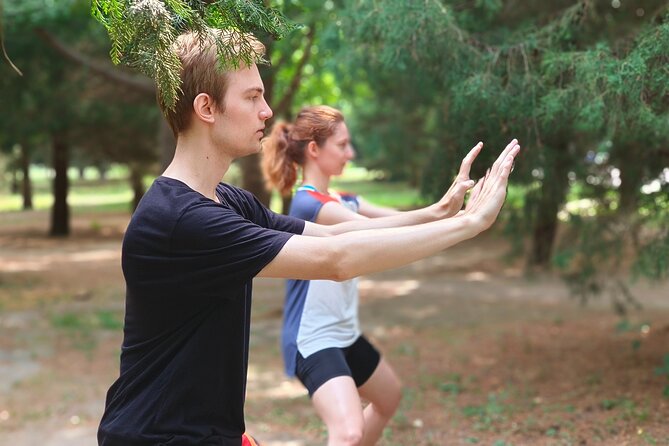
- Practical kung fu basics: stances, kicks, and punches, taught in a way you can follow fast
- A set form you can remember: the kung fu five stance fist form
- Technique focus: joint-locking and self-defend techniques, not just pose-and-smile
- Worth the setting: class runs in the Temple of Heaven area, often shaded by trees
- All-group ages work: multiple age ranges were handled well, including kids with adults present
- Private feel: only your group participates
You can also read our reviews of more tours and experiences in Beijing

Why this Beijing kung fu class feels more grounded
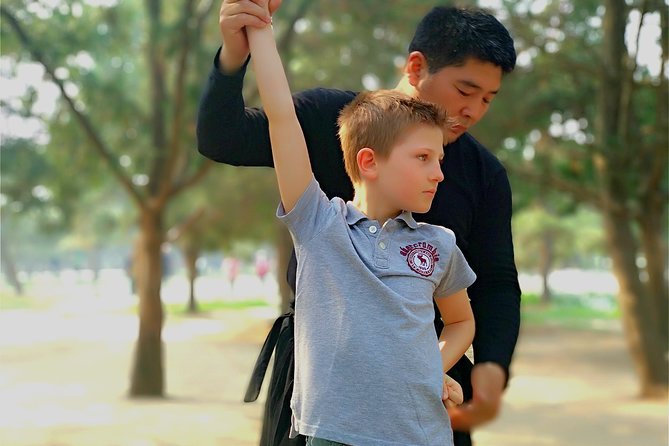
Beijing is full of performances, but this experience is about doing. Instead of watching someone show off, you get guided training that connects kung fu’s look with how the body moves. Kung fu here isn’t treated as a movie stunt; it’s explained as training for offense/defense, plus discipline and aesthetics—so the class has a “why” along with the “how.”
The biggest bonus is the location mood. Meeting near the Temple of Heaven area puts you in a place people already come to for calm and atmosphere, and the class setting can be shade-by-trees style. That matters more than you’d think. When the body is comfortable, you can actually concentrate on footwork, posture, and control.
That outdoor vibe also helps explain something important about kung fu: control. A teacher can correct your stance without you feeling like you’re trapped in a studio. You get more space to move safely.
What you actually learn in 90 minutes
This class is built like a mini training session with clear progress. You start with fundamentals, then you layer in a set sequence, then you finish with partner-style self-defense ideas (taught with care).
Here’s the flow you can expect:
First, you’ll get basic kung fu training: stances, kicks, and punches. Expect a teacher-led warmup feel—gradual setup, then repetition to make the movements stick. This is where beginners gain confidence fast, because you aren’t trying to memorize complicated choreography right away.
Next comes the kung fu five stance fist form. A “five stance” form is useful because it forces you to coordinate stance changes with arm actions. You’re basically learning how balance, direction, and intent work together.
Then you move into joint-locking techniques. These are the kinds of moves that show up in self-defense stories because they focus on control. The point isn’t to turn you into an action hero; it’s to teach the concept of using leverage and positioning rather than brute strength.
Finally, you practice self-defend techniques. Even if you only remember a couple of key ideas after class, you’ll leave with a clearer sense of how kung fu is framed as defense and moral discipline—not just fighting.
The five-stance fist form: why it’s a smart beginner target
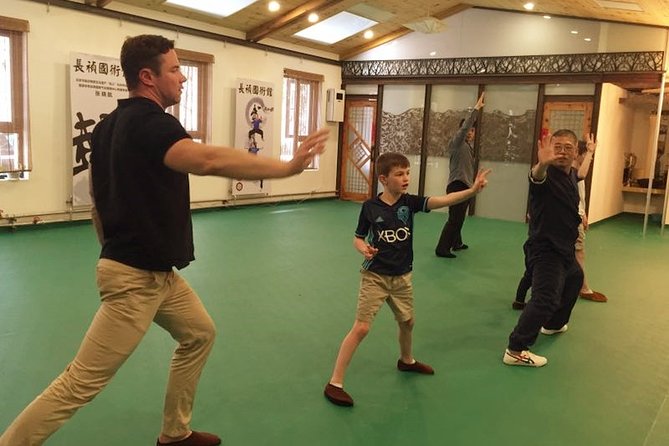
A lot of short martial arts experiences stop at a handful of punches and kicks. This one includes a form—the five stance fist form—which is a better use of 90 minutes than it sounds.
A form gives you structure. You’re not trying to come up with moves on your own. You follow a sequence, and the teacher keeps bringing you back to what matters: stance stability, weight shift, and clean arm lines. That’s the difference between flailing and learning.
It also helps with memory. Humans remember stories and patterns. A five-stance form is short enough to grasp without feeling overwhelmed, but it’s long enough to feel like you truly did kung fu training, not just “tried a move.”
If you care about “value per minute,” a form like this is a win. It turns a one-time class into a repeatable reference you can practice later.
Joint-locking and self-defense: learn the concept, not the hype
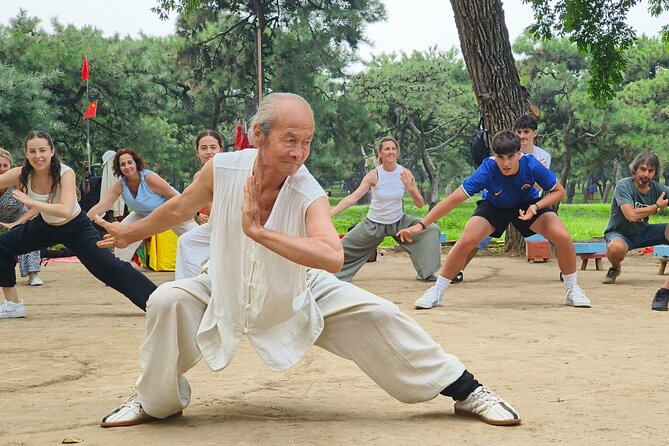
Joint-locking techniques can sound intimidating if you only associate them with fight scenes. Here, the class approach is about learning control and body positioning. You’re not just throwing techniques; you’re understanding the mechanics that make control possible.
What I like in this setup is the combination: joint-locking plus self-defend techniques. One teaches the leverage idea; the other gives the broader defensive mindset. Together, they help you connect moves to outcomes.
A practical note: you should go in with a cooperative attitude. In a short class, the goal is safe practice and clear instruction, not proving anything to anyone. If you respect the learning pace, you’ll get more out of it.
And because it’s a group class, you’ll likely see how your timing compares to other students. That’s useful feedback. You might also notice that the teacher focuses on posture and alignment before speed—exactly what beginners need.





Stances, kicks, punches: where real progress starts
Kung fu starts with feet. Stances aren’t just “standing nicely.” They affect your balance, your ability to pivot, and your ability to generate power through the hips instead of arms alone.
This course includes the essentials: stances, kicks, punches. That means you leave with a foundation you can keep building on even after the class ends. If you’re new, you’ll appreciate how the instructor builds the movements step by step. If you have experience in another martial art, you can compare differences in posture and rhythm.
One subtle advantage: when you practice basic moves inside a short lesson plan, you get more corrections. That’s usually where your technique improves fastest—small adjustments made early and repeated until they feel normal.
Meeting point near Tian Tan Dong Lu: keep it simple
The meeting point is listed at 旻园1 Tian Tan Dong Lu, Dong Cheng Qu, Bei Jing Shi, China, 100061, and the activity ends back at the meeting point.
You don’t get hotel pickup and drop-off, so you’ll want to be ready to arrive on your own. The good news is it’s described as near public transportation, which makes it easier to slot into a sightseeing day.
If you’re building a Temple of Heaven itinerary, plan this class for when you can focus. You’ll be learning movements, not just sightseeing. A rested body also helps your learning and keeps the session enjoyable.
Price and value: is $65 worth it?
At $65 per person for about 1 hour 30 minutes, this class is priced like a solid activity, not a token demo. The value comes from what’s included and how the class is structured.
You get:
- a high qualified kung fu master
- an entrance ticket (with a note that the activity also mentions an admission ticket not included, so it’s worth confirming what you need for the Temple of Heaven area access)
You also benefit from:
- a private group setup (only your group participates)
- group discounts
- a mobile ticket
That “private feel” matters. In a group setting where it’s just your party, the instructor can spend more time correcting and checking technique. If you’re traveling with family or friends, that can make the class feel more tailored than a big public workshop.
Is it a deal? For the time spent and the range of content—basic training, a form, joint-locking, and self-defense—it’s a fair price. It’s also a great option when you want a hands-on cultural activity without committing to a long multi-day course.
Who should book this kung fu experience
This is the kind of class that works for many ages, as long as kids come with an adult and everyone meets the moderate fitness level.
You’ll especially enjoy it if:
- you want a hands-on cultural experience tied to traditional practice
- you’re curious about kung fu beyond movies
- you like structured learning (not just random movement)
- you want a memorable activity that stays active for 90 minutes
It may be less ideal if you’re looking for a lightweight stretching class only. This is movement training. Even with beginner-friendly instruction, you’ll be practicing stances and kicks.
If you’re traveling with kids, it’s a strong pick because the instruction style has been described as fun and engaging for both adults and children, keeping interest levels up during the full session.
Style of instruction: what the teaching seems to emphasize
From the experience descriptions and outcomes shared, the teaching approach is practical and student-focused. In at least one case, the instructor was kung fu master Liu, described as kind, enthusiastic, and providing English instruction that helped non-Chinese speakers follow along.
That’s a big deal. When language is clear, you learn faster and feel safer. Kung fu instruction depends on corrections: where your foot lands, how your knees align, how your shoulders stay relaxed. Clear guidance keeps you from guessing.
Also, the class environment helps. Past participants noted training in the shade of trees, with a bit of music. That’s not just atmosphere—it can make repetition more enjoyable, especially when you’re doing the same stance shift or punch line multiple times.
Should you book this Beijing kung fu class?
If you want something active, cultural, and structured, yes, consider booking. This class hits a sweet spot: enough time to actually learn fundamentals and a form, but short enough to fit into a normal Beijing sightseeing schedule.
Book it if:
- you want beginner-friendly kung fu training with a real instructor
- you’d like to take home a form sequence you can practice again
- you’re traveling as a group and prefer your own group experience
Pass or rethink if:
- you need an activity with no physical movement beyond light walking
- you’re unsure about whether you’ll need extra admission for the Temple of Heaven area (since the info says entrance ticket included, but also says admission ticket not included)
If you’re on the fence, send a quick message to confirm what the included ticket covers. Once that’s clear, this is a great way to turn “kung fu looks cool” into “I can actually do this.”
FAQ
How long is the Chinese Kung Fu Experience class in Beijing?
The class runs for about 1 hour 30 minutes.
What does it cost?
The price is $65.00 per person.
Who teaches the class?
The class is taught by a high qualified kung fu master.
Is an entrance or admission ticket included?
The details list an entrance ticket as included, but the activity notes admission ticket not included. To avoid surprises, confirm whether you need any separate admission for the Temple of Heaven area.
Is the class private?
Yes. Only your group will participate.
Do children need to be with an adult?
Yes. Children must be accompanied by an adult.
Do I need to be very fit?
You should have a moderate physical fitness level, since you will be practicing stances and techniques during the full session.