REVIEW · BEIJING
Beijing Culture: Tea Ceremony, Heritage Instrument & Calligraphy
Book on Viator →Operated by Culture Heritage Tour China · Bookable on Viator
The calmest culture lesson in Beijing. I love the tea ceremony taught by a certified tea master, and I love how the Guqin lesson is hands-on, with real guidance on your fingers instead of passive watching. One possible drawback: you need to handle your own ride to the meeting point at 813 Creative Park, and this isn’t a quick hop-on stop between sightseeing.
This is a 2.5-hour, small-group workshop (max 8 people) in a private Beijing heritage venue that stays closed to the public. You get a bilingual guide with an M.A. in History & Sociology, and you’ll work with national-level cultural masters in a quiet, air-conditioned space that feels like stepping out of the noise.
In This Review
- Key things that make this Beijing workshop worth your time
- A private heritage venue in Chaoyang where the pace slows down
- Tea ceremony: more than hot water and pretty cups
- Guqin performance and your own finger work on the strings
- Chinese calligraphy: writing characters with meaning, not just strokes
- Traditional outfit rental for ritual photos (and a confidence boost)
- Price and logistics: is $78.60 worth it?
- Who this workshop is best for (and who should skip it)
- Should you book this Beijing tea ceremony, guqin, and calligraphy workshop?
- FAQ
- What is included in the Beijing tea, guqin, and calligraphy workshop?
- Is this a show or a hands-on class?
- How long is the experience?
- How many people are in the group?
- Where do I meet the guide?
- Is transportation provided to and from the venue?
- Does the experience have language support?
- What happens if weather is poor?
- Can I get a full refund if I cancel?
Key things that make this Beijing workshop worth your time
- Tea ceremony with tea tasting led by a certified tea master, not a script
- Guqin play session plus a live performance by a national-level heritage artist
- Chinese calligraphy practice with expert guidance, including brushwork basics
- Traditional outfit rental so the ritual feels real (and photos look great)
- Small group limit (8 max) for a calmer pace and more personal help
A private heritage venue in Chaoyang where the pace slows down
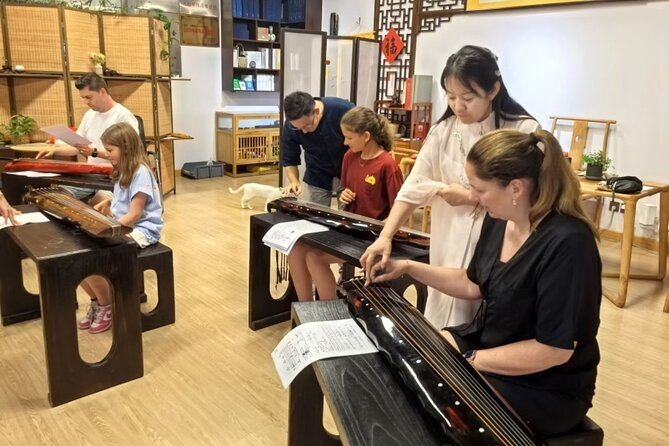
Beijing has plenty of things to see. This experience is about slowing down and learning how Chinese culture works when you’re not rushing. The workshop takes place in a private heritage venue that’s closed to the public, and it’s described as air-conditioned and peaceful, which matters in a city where you can easily lose the plot to heat, traffic, and crowds.
The small group size (8 maximum) is a big deal. In a class this hands-on, the difference between 8 people and 30 people is whether you actually get corrected, helped, and answered in real time. You’ll also notice the tone right away: this isn’t built like a performance schedule. It’s built like a practice session.
Another practical plus: it’s near public transportation, and the meeting point is clear—813 Creative Park in Chaoyang District. Still, transportation isn’t included, so plan a straightforward route ahead of time so you arrive unflustered and ready to concentrate.
Finally, you’ll be guided in English by a bilingual staff member with an M.A. in History & Sociology. That education background shows in the way the explanations are framed around meaning—why the rituals exist—not just what you’re supposed to do.
You can also read our reviews of more historical tours in Beijing


Tea ceremony: more than hot water and pretty cups
Tea ceremony in China can look simple from far away. In this workshop, you’re not just shown steps—you’re part of them. You’ll take part in a traditional tea ceremony with tea tasting, led by a certified tea master. The point isn’t only the taste; it’s the sequence, the attention, and the cultural logic behind the ritual.
What I like about this segment is that it treats tea as a cultural skill. You brew and taste real Chinese tea, and you learn how the ritual supports focus and respect. That matters if you’ve ever done a tea experience that feels like a sales pitch or a photo op. Here, the tea is tied to learning.
You’ll also get a small break in the middle of the day’s mental load. Even if your Beijing plan is packed with temples and markets, this tea time works like a reset button. It gives you something tangible to concentrate on—heat, aroma, the feel of the cup—so you’re not only collecting sights, you’re collecting sensory memory.
One more detail worth planning for: you’ll likely be given tea snacks as part of the experience. That can help you avoid a mid-lesson hunger spiral, especially because the full session is 2 hours 30 minutes and you’ll want to stay present through the music and calligraphy.
Guqin performance and your own finger work on the strings
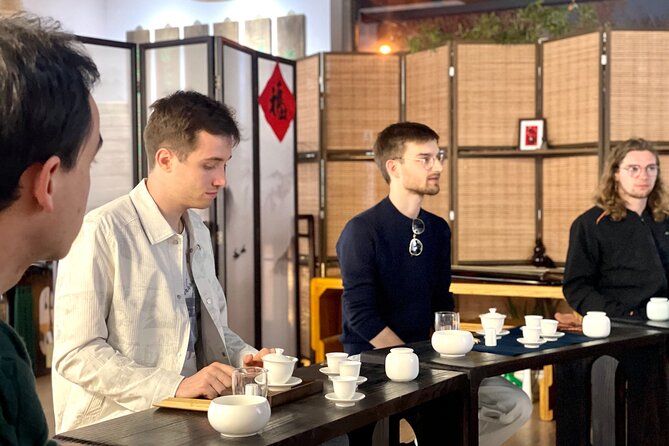
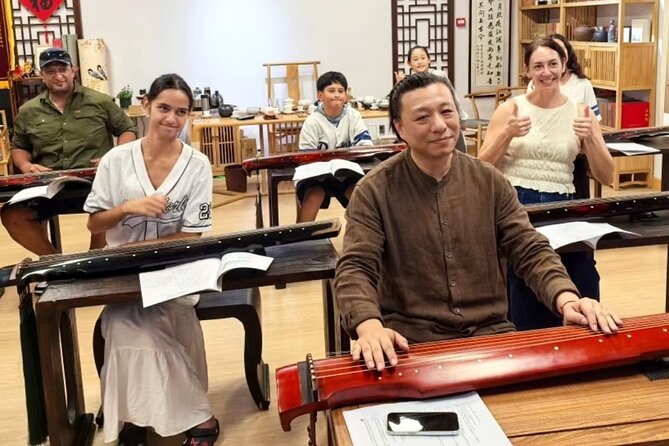
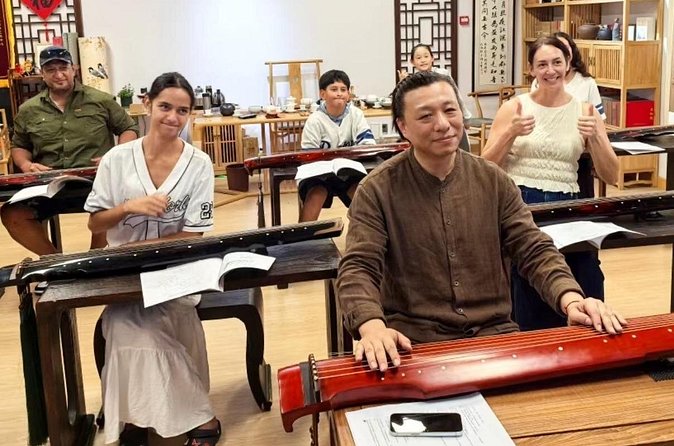
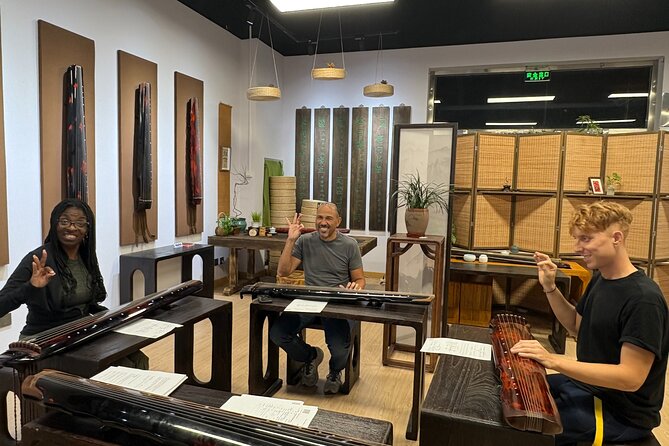
The guqin is China’s revered ancient zither, and it’s easy to underestimate how technical it can be until you sit down with someone who plays it for real. This workshop includes a live guqin performance by a national-level heritage artist, then a hands-on learning session where you’ll learn how to play a full melody.
What makes the guqin portion special is the combination: you hear a proper performance first, then you get guided instruction and actual practice. That sequence helps your brain connect sound to technique. Instead of copying hand motions blindly, you have a reference for how the music is supposed to land.
The hands-on part is also the main reason this doesn’t feel like a show. In a typical demo, you watch. Here, you try. And because the group is capped at 8, the guide can correct what you’re doing—especially on finger placement and timing, which is where most people struggle.
If you’re the type who thinks music lessons are only for people with a long background, this is a good reality check. You don’t need to be a musician to enjoy it. You do need patience, because even small corrections can take a few tries to feel comfortable. That’s part of the value: you’re learning a tradition that takes time to master, but you get to experience it directly in one afternoon.
Chinese calligraphy: writing characters with meaning, not just strokes
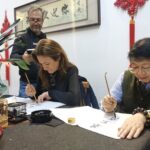
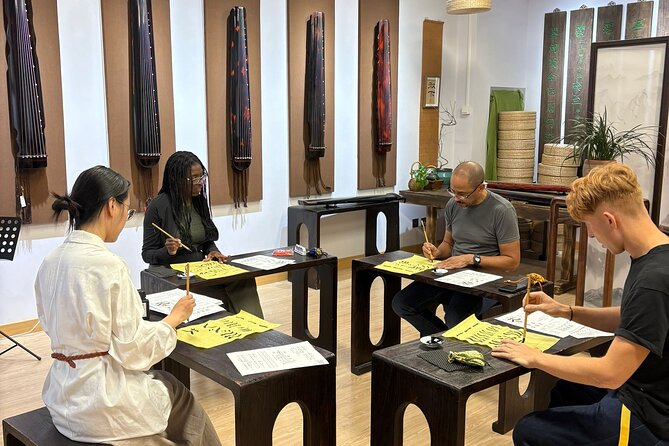
Calligraphy is often treated like a cool cultural activity you try for 15 minutes. Here, it’s built as a learning segment with expert guidance. You’ll write meaningful Chinese characters in traditional calligraphy style, and you’ll also get context about ancient roots and structure—so it’s not only about making something pretty.
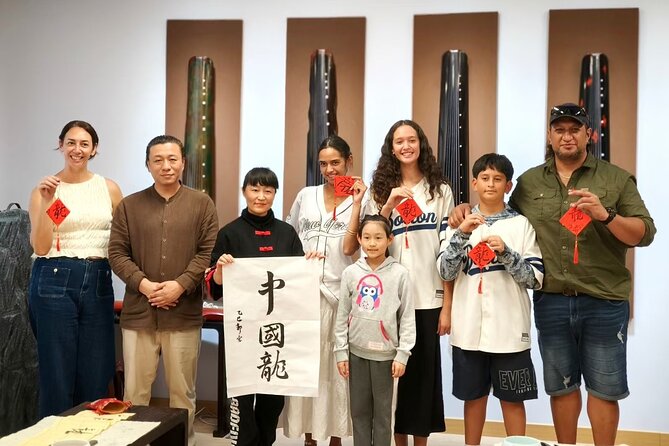
During the workshop, the calligraphy instructor helps you work through brush technique and character formation. The goal is understanding enough to write your own character(s) with intention. If you’re hoping to walk away with something you can actually use at home, this is one of the best parts of the experience.
In the experience format, you can expect to write something personal—there’s a strong emphasis on crafting a result you’ll keep. One of the most practical moments people remember is being helped to write their Chinese name, then taking the paper home afterward. That’s the kind of souvenir that feels like a cultural artifact you made, not a plastic thing you bought.
Calligraphy also has a mental benefit. It forces you to slow down the hand. After tea and guqin, it’s a nice final transition: from hearing, to doing music, to doing writing. If you’re tired of learning from screens, this is the kind of task that pulls your attention back into your own body.
Traditional outfit rental for ritual photos (and a confidence boost)
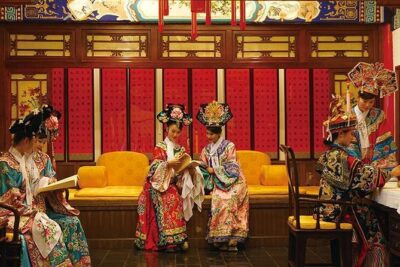
You also get traditional outfit attire rental as part of the workshop. This is a smaller inclusion compared to tea, guqin, and calligraphy, but it changes the feeling of the experience. Wearing the outfit helps the ritual land as something cultural and lived, not something you borrow for an hour and forget.
It also makes the photo moment genuinely better. Since the setting is quiet and heritage-themed, your photos won’t look like typical souvenir chaos. And because the environment is designed for this activity, the dress rental feels like it belongs in the flow rather than stapled on at the end.
This matters more than people think. When you’re doing calligraphy and learning a melody, you’re investing focus. The outfit is part of the same mindset: slow, respectful, and present.



Price and logistics: is $78.60 worth it?
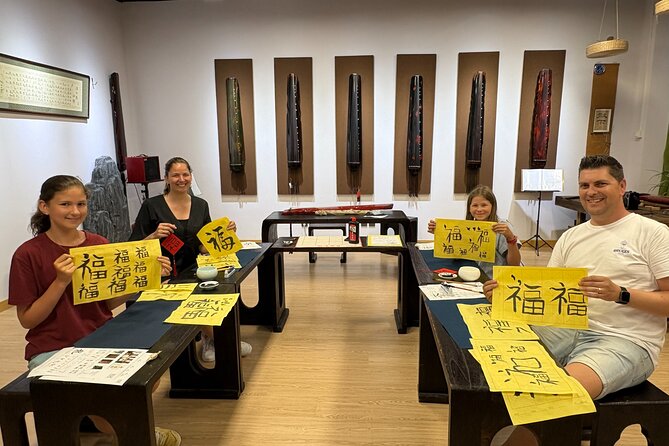
At $78.60 per person for about 2.5 hours, you’re paying for more than a craft session. You’re paying for three major cultural practices—tea ceremony, guqin (performance plus learning), and calligraphy—delivered in a small group by national-level cultural masters, with English explanation from an M.A.-qualified bilingual guide.
That value holds up because the structure is hands-on. Many cultural experiences are “watch, then leave.” This one is “learn, do, and get corrected.” And you’re also getting outfit rental and tea snacks, which nudges the cost closer to what you’d spend if you hired separate instructors yourself.
Two practical cautions keep it honest:
- Transportation is not included. Plan to get yourself to 813 Creative Park.
- Good weather matters. The experience requires good weather, so be ready for date changes if conditions are poor.
One more practical tip: book ahead. The average booking timing is about 51 days in advance, which hints that slots can fill. With only 8 spots per session, earlier is safer if you have fixed trip dates.
Who this workshop is best for (and who should skip it)
This is ideal if you want Beijing culture that’s quiet, hands-on, and respectful. It’s especially good for people who are tired of crowds and want something that feels like learning from practitioners, not watching actors in costume.
You’ll likely enjoy it if:
- you like classes where you do the work, not just watch
- you want a break from the sightseeing treadmill
- you’re interested in Chinese culture through practical traditions like tea, music, and writing
You might want to skip it if:
- you only have time for the biggest headline sights
- you dislike structured lessons and prefer roaming freely
- you need a fully spontaneous plan on the day (since it has a fixed 2.5-hour structure)
If you’re not sure whether you’ll like tea, calligraphy, or guqin, don’t overthink it. The workshop is designed for normal participation, and the guidance is in English. You can arrive without prior skills and still leave with something you made and understood.
Should you book this Beijing tea ceremony, guqin, and calligraphy workshop?
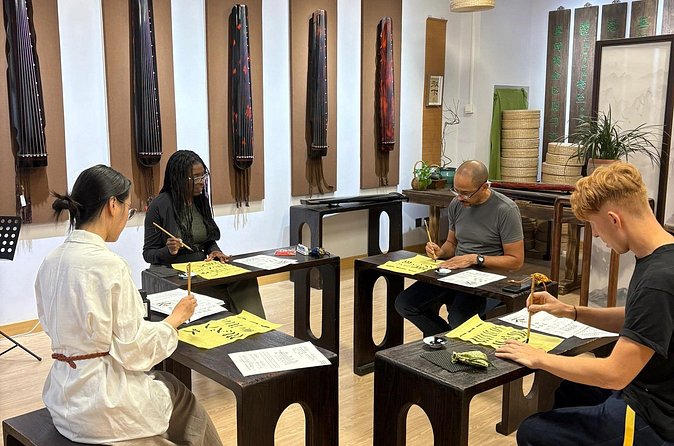
If you want one experience in Beijing that feels calm, personal, and genuinely cultural, this is a strong pick. The combination of tea ceremony practice, a guqin melody lesson, and calligraphy instruction is rare in one place. And because the group is limited to 8 people in a private venue, you get more than surface-level learning.
Book it if you value meaning over spectacle, and if you’re willing to get yourself to the meeting point at 813 Creative Park. If you want a lively, crowd-filled show, this isn’t that. But if you want a quiet hour-and-a-half of real practice—followed by music and writing you can keep thinking about—that’s exactly what this format is built for.
FAQ
What is included in the Beijing tea, guqin, and calligraphy workshop?
The experience includes a traditional tea ceremony and tea tasting with a certified tea master, a live guqin performance plus a hands-on guqin learning session, a Chinese calligraphy workshop with expert guidance, traditional outfit attire rental, and a bilingual guide with an M.A. in History & Sociology.
Is this a show or a hands-on class?
It’s designed as a hands-on workshop. You’ll brew and taste tea, learn during the guqin session, and write in a calligraphy workshop with guidance.
How long is the experience?
It runs for about 2 hours 30 minutes.
How many people are in the group?
The group size is capped at a maximum of 8 travelers.
Where do I meet the guide?
Meet at 813 Creative Park (VGP3+CCX, Chaoyang, China, 100124). The activity ends back at the meeting point.
Is transportation provided to and from the venue?
No. Transportation to and from the venue is not included.
Does the experience have language support?
Yes. The guide is bilingual and the workshop is guided in English.
What happens if weather is poor?
The experience requires good weather. If it’s canceled due to poor weather, you’ll be offered a different date or a full refund.
Can I get a full refund if I cancel?
Yes. You can cancel for a full refund up to 24 hours before the experience’s start time. Free cancellation is available.